For many sign shops, estimating is where every project begins.
A customer asks for a storefront sign, vehicle graphics, or a full fleet wrap. The shop prepares a quote, sends it over, and hopes the numbers are accurate enough to protect profit while still winning the job.
At first glance, estimating may seem straightforward. But behind the scenes, a good estimate needs to account for several variables: materials, design time, fabrication, installation labor, scheduling, and possible revisions.
When these factors are calculated manually, mistakes become surprisingly common.
That’s why many growing shops are turning to sign shop estimating software. Instead of building estimates from scratch each time, dedicated tools help standardize pricing, reduce human error, and move projects smoothly from quote to completion.
But before choosing a platform, it’s important to understand what the right system should actually include.
The best solutions don’t solely create quotes, they support the entire workflow of a sign shop.
Let’s look at the features that truly matter.
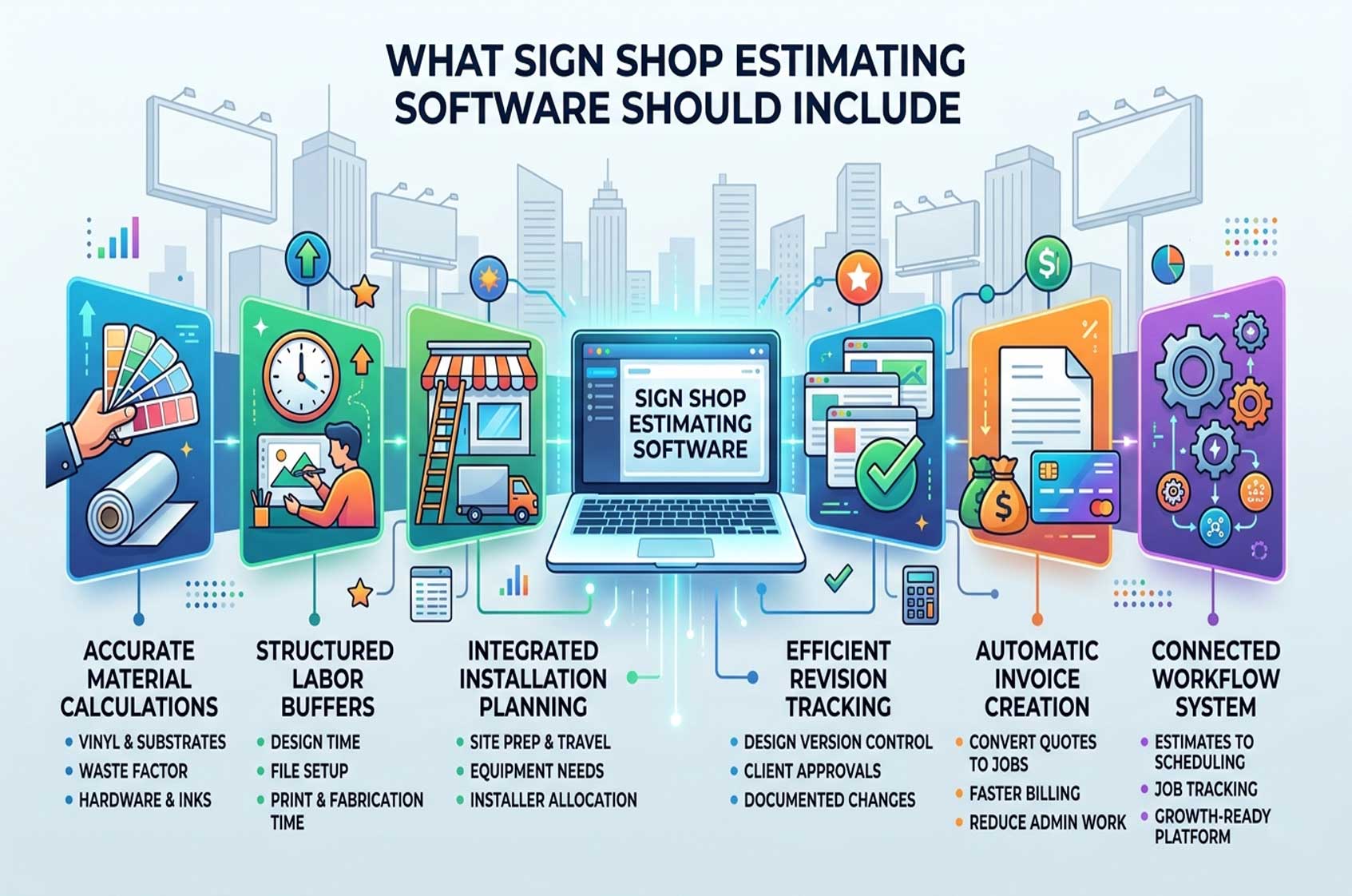
Material calculations that prevent costly underestimates
Materials are often the largest cost component of any signage project.
Vinyl, substrates, laminates, inks, mounting hardware, and specialty finishes all contribute to the final price. When estimating is handled manually, it’s easy to overlook small but important details.
A slight miscalculation in vinyl coverage or substrate size can quickly turn a profitable job into a loss.
This is where structured sign shop estimating software becomes valuable.
Instead of relying on rough calculations, software can automatically account for material usage based on job specifications. For example, a system might factor in:
- Surface area requirements
- Material waste or overage
- Laminates and finishing layers
- Hardware or mounting components
These automated calculations help make sure that every quote reflects the true cost of production.
For busy sign shops handling multiple estimates each week, this level of accuracy protects profit margins while also speeding up the quoting process.
Labor buffers that account for real production time
Material costs are only part of the equation.
Labor is often the most underestimated component of a signage project.
Design revisions, fabrication complexity, and preparation work can all extend the time required to complete a job. When estimators forget to include these buffers, shops end up absorbing the extra work without being compensated.
A good estimating system should help prevent this problem.
Modern digital sign shop software allows shops to structure labor calculations using predefined workflows. Instead of estimating labor from memory, the system can apply consistent time estimates based on job type.
For example, the software might automatically include labor buffers for:
- Design preparation
- File setup and proofing
- Printing and fabrication
- Finishing and trimming
- Packaging or preparation for installation
By standardizing how labor is calculated, sign shops avoid the inconsistencies that often occur when different team members create quotes in different ways.
Over time, these structured estimates lead to more predictable profit margins.
Installation time planning built into the estimate
Installation is another area where estimating errors frequently occur.
A sign may appear simple on paper, but the installation might require ladders, lifts, multiple installers, travel time, or coordination with property managers.
If install time isn’t considered during the estimating stage, scheduling conflicts and rushed jobs can follow.
Effective sign shop estimating software includes installation planning as part of the quoting process.
Rather than adding install costs as an afterthought, the system allows shops to incorporate installation variables directly into the estimate.
These might include:
- Number of installers required
- Estimated installation duration
- Travel time to the job site
- Equipment requirements
- Site preparation or removal of existing signage
When installation time is built into the original quote, the shop can plan schedules more accurately and avoid last-minute surprises.
This approach also helps maintain a realistic workload for installers, preventing burnout and rushed projects.
Revision tracking that keeps projects organized
Customer revisions are a normal part of the signage process.
A client may request changes to colors, layout, dimensions, or messaging before approving the final design. Without an organized system, these revisions can quickly become confusing.
Many sign shops rely on long email threads to track feedback. Unfortunately, that method often leads to version control problems.
Someone might accidentally reference an outdated design, or fabrication might begin before the final proof is approved.
The right digital sign shop software introduces structured revision tracking.
Instead of managing revisions through scattered messages, the system keeps every version of the design connected to the project. Changes are documented, approvals are recorded, and everyone involved can clearly see the latest version.
This reduces the risk of costly mistakes and keeps communication between the shop and the client transparent.
For sign shops managing multiple projects at once, organized revision tracking saves significant time.
Automatic invoice creation after approval
Estimating should not exist as a separate process from billing.
In many shops, estimates are created in one tool while invoices are generated later in accounting software. This separation creates duplicated work and increases the chance of missing information.
One of the biggest advantages of modern sign shop estimating software is automation between quoting and invoicing.
Once a quote is approved, the system can automatically convert it into a job and generate the corresponding invoice. The details from the estimate carry forward, eliminating the need to re-enter data.
This automation helps shops:
- Reduce administrative work
- Prevent billing mistakes
- Send invoices faster
- Improve cash flow
For busy sign businesses, these small improvements can save hours each week.
More importantly, they make sure the financial side of the project stays aligned with the original estimate.
A structured system that connects the entire workflow
The best estimating tools don’t operate in isolation.
Instead, they connect with other parts of the shop’s workflow, creating a seamless transition from inquiry to completed job.
This is where many shops begin to adopt broader digital sign shop software rather than standalone estimating tools. A fully integrated system allows estimates to flow directly into scheduling, production tracking, proof approvals, and invoicing.
Instead of switching between multiple platforms, the shop operates within a single organized environment.
This centralized approach improves visibility across projects and ensures every team member understands the current status of each job.
Why many sign shops choose GarageTool
GarageTool was designed specifically for wrap and sign shops that want to simplify the estimating process while connecting it to the rest of their operations.
Instead of creating estimates in isolation, GarageTool integrates quoting with scheduling, job tracking, proofing, and invoicing.
With GarageTool, sign shops can:
- Generate accurate estimates using structured pricing
- Automatically calculate materials and labor
- Include installation time directly in quotes
- Track design revisions and approvals
- Convert approved quotes into jobs and invoices automatically
By bringing these processes together, GarageTool helps shops move from estimate to completed installation without the confusion that comes from juggling multiple tools.
For growing sign shops, this structure allows teams to handle more projects without increasing administrative workload.
Choosing estimating software that supports growth
Selecting the right sign shop estimating software isn’t just about creating faster quotes.
It’s about building a system that protects profit margins, improves organization, and supports the way your shop actually works.
When estimating includes accurate material calculations, structured labor buffers, installation planning, revision tracking, and automated invoicing, the entire workflow becomes smoother.
Projects move forward with fewer surprises, customers receive clearer communication, and teams spend less time on repetitive administrative tasks.
That’s why many modern shops are moving toward integrated digital sign shop software like GarageTool.
With the right system in place, estimating becomes the foundation of a well-organized and scalable sign business.
- ©2026 GarageTool
- Privacy policy
- Terms of service
- Sitemap