Why most sign shops are running on too many tools
Walk into almost any growing sign shop and you’ll see the same pattern.
Not in the printers or the installs, but in the software.
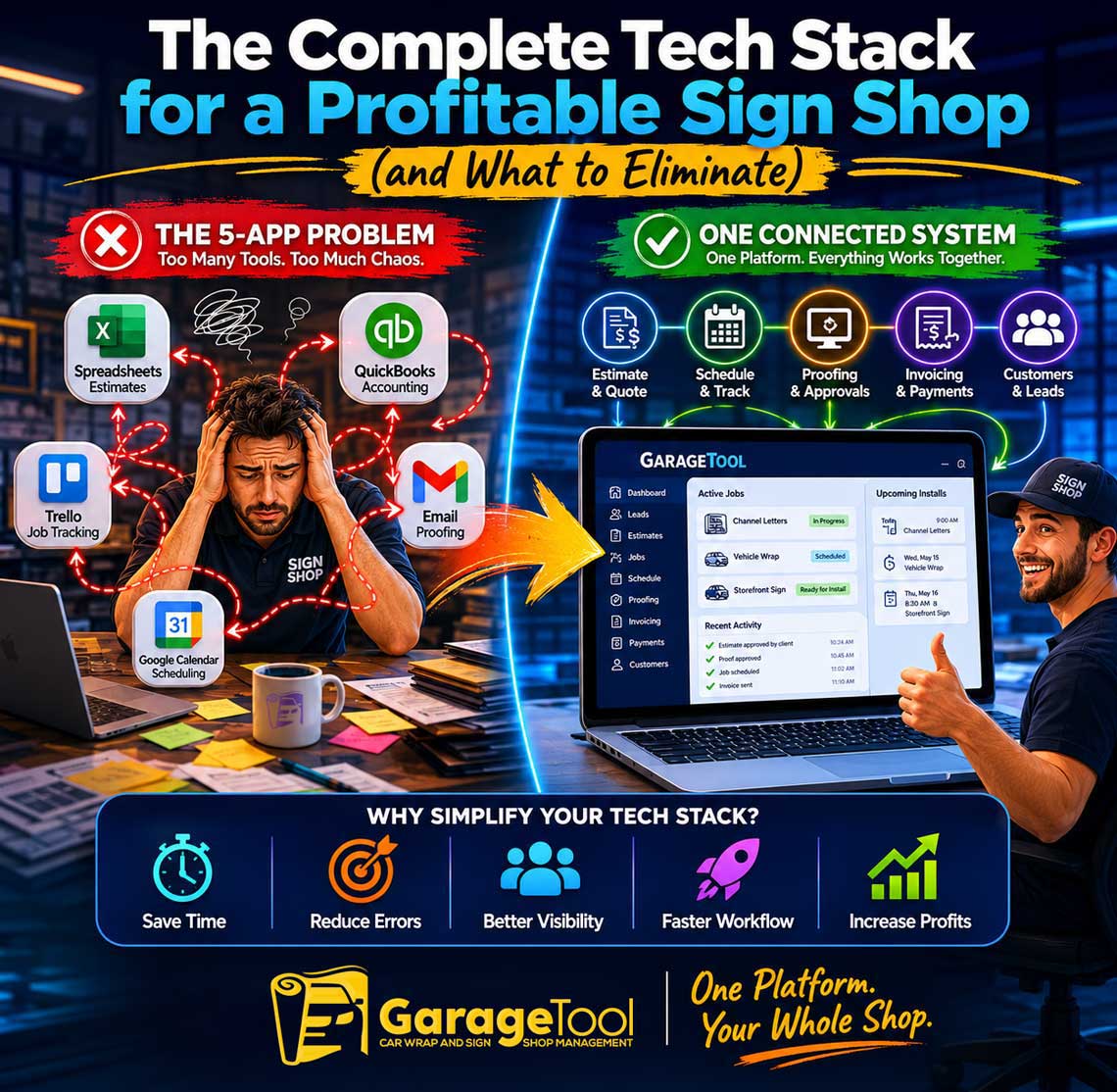
One screen has a spreadsheet open. Another has QuickBooks. Someone else is checking Google Calendar. A Trello board tracks jobs. Emails are flying back and forth with proofs attached.
Individually, each tool makes sense.
Together, they create friction.
This is what many shop owners don’t realize early on: the problem isn’t the tools themselves—it’s the fact that they don’t work together.
Over time, this patchwork becomes your business tech stack. And if it’s not designed intentionally, it can quietly slow down your entire operation.
Let’s break down the “5-app problem” that most sign shops face—and what a better system actually looks like.
The 5-app problem inside most sign shops
Most shops don’t start with five tools.
They add them gradually.
A spreadsheet for estimates. Then QuickBooks for accounting. Then Trello for tracking jobs. Then Google Calendar for installs. Then email for proofing.
Each addition solves a short-term need.
But over time, they create long-term complexity.
1. Spreadsheets: flexible, but fragile
Spreadsheets are usually the first tool.
They’re simple, customizable, and free.
But as soon as the shop grows, they become harder to manage.
- estimates are built manually
- formulas can break
- pricing becomes inconsistent
- updates depend on someone remembering to enter them
Spreadsheets don’t scale well because they rely entirely on manual input.
2. QuickBooks: necessary, but disconnected
Accounting software is essential.
QuickBooks handles invoices, payments, and financial tracking—but it typically lives outside the rest of the workflow.
That creates a disconnect:
- estimates are created elsewhere
- job details have to be re-entered
- payments aren’t always tied to project status
- financial data lags behind operations
This is where your finance tech stack starts to separate from your actual workflow.
3. Trello (or similar tools): visual, but incomplete
Project boards like Trello are often used to track jobs.
They provide a visual way to see what’s in progress.
But they’re not built specifically for sign shops.
- job details may be limited
- updates rely on manual movement
- no direct connection to estimates or invoices
- team members still need other tools to complete tasks
It becomes one more place to check, rather than a true system.
4. Google Calendar: helpful, but isolated
Scheduling installs and jobs usually ends up in a shared calendar.
It works for basic visibility.
But it’s disconnected from everything else.
- install dates aren’t tied to job details
- changes may not reflect across systems
- team members need additional context from other tools
- double-bookings and conflicts still happen
A calendar alone doesn’t create coordination. It just displays it.
5. Email proofing: where everything slows down
Proofing through email is one of the biggest hidden inefficiencies.
It feels simple—send a design, wait for feedback.
But in reality:
- revisions get buried in threads
- version control becomes confusing
- approvals aren’t clearly documented
- communication takes longer than it should
As project volume increases, this becomes a major bottleneck.
What happens when these tools are combined
Individually, none of these tools are “bad.”
The issue is how they interact.
Or more accurately—how they don’t.
When your tech stack is made up of disconnected tools:
- information has to be entered multiple times
- team members switch between platforms constantly
- updates fall out of sync
- mistakes become more likely
- admin time increases
The result is a system that requires constant effort just to keep running.
And that effort grows as your shop grows.
The shift: from tool stack to system
The most efficient sign shops don’t rely on more tools.
They rely on fewer (but more connected) systems.
Instead of stitching together a fragmented business tech stack, they move toward platforms that handle multiple parts of the workflow in one place.
This changes how the shop operates.
What a modern sign shop tech stack actually looks like
A streamlined system replaces multiple tools with one connected workflow.
Instead of five separate platforms, everything works together.
A unified system should handle:
- estimating and quoting
- job tracking and production status
- scheduling and install coordination
- proofing and approvals
- invoicing and payments
- customer and lead management
This is where sign shop quote software evolves into something more powerful—a complete operational system.
The advantages of simplifying your tech stack
Moving from five tools to one system isn’t just about convenience.
It changes the way your business runs.
1. Less duplication
Information is entered once and used everywhere.
No more copying details from spreadsheets into invoices or calendars.
2. Better visibility
Everyone works from the same system.
That means:
- clearer job status
- better team coordination
- faster decision-making
3. Fewer mistakes
When systems are connected:
- updates happen automatically
- data stays consistent
- errors from manual entry are reduced
4. Faster workflow
Without switching between tools:
- quotes go out quicker
- jobs move faster
- communication improves
- projects stay on track
5. Stronger profitability
Less admin time + fewer errors = better margins.
Simplifying your tech stack doesn’t just save time—it protects profit.
What to eliminate (and why it matters)
Upgrading your system isn’t about adding more tools.
It’s about removing unnecessary ones.
Consider eliminating:
- spreadsheets for estimating
- disconnected scheduling tools
- manual proofing through email
- duplicate data entry between systems
- standalone job tracking boards
Each removal reduces friction.
And when friction decreases, efficiency increases.
Where GarageTool fits into a modern tech stack
GarageTool was built specifically to replace the fragmented systems most sign shops rely on.
Instead of combining multiple tools, GarageTool brings everything into one platform:
- estimating and quoting
- scheduling and job tracking
- proofing and approvals
- invoicing and payments
- automation and notifications
This eliminates the need for a scattered business tech stack and replaces it with a structured system designed for how sign shops actually operate.
It also bridges the gap between operations and your finance tech stack, keeping estimates, invoices, and payments connected.
The difference you feel when your tools finally work together
When your systems are connected, the change is noticeable.
Your team spends less time switching between tools.
You spend less time answering questions about job status.
Customers get faster responses.
Projects move forward with fewer delays. And instead of managing your tools, your tools support your business.
Simplify your stack, strengthen your shop
If your shop is currently running on five different tools, you’re not the only one.
But that setup isn’t built for long-term growth.
At some point, the complexity starts to slow you down.
The most profitable shops recognize when it’s time to simplify. They move from disconnected tools to connected systems—and that shift changes everything.
Ready to replace your tech stack with a system that actually works?
GarageTool helps sign shops eliminate scattered tools and manage their entire workflow (from quote to payment) in one place.
See how GarageTool can simplify your tech stack and help your shop run more efficiently.
- ©2026 GarageTool
- Privacy policy
- Terms of service
- Sitemap