Why modern sign shops are replacing spreadsheets with dedicated software
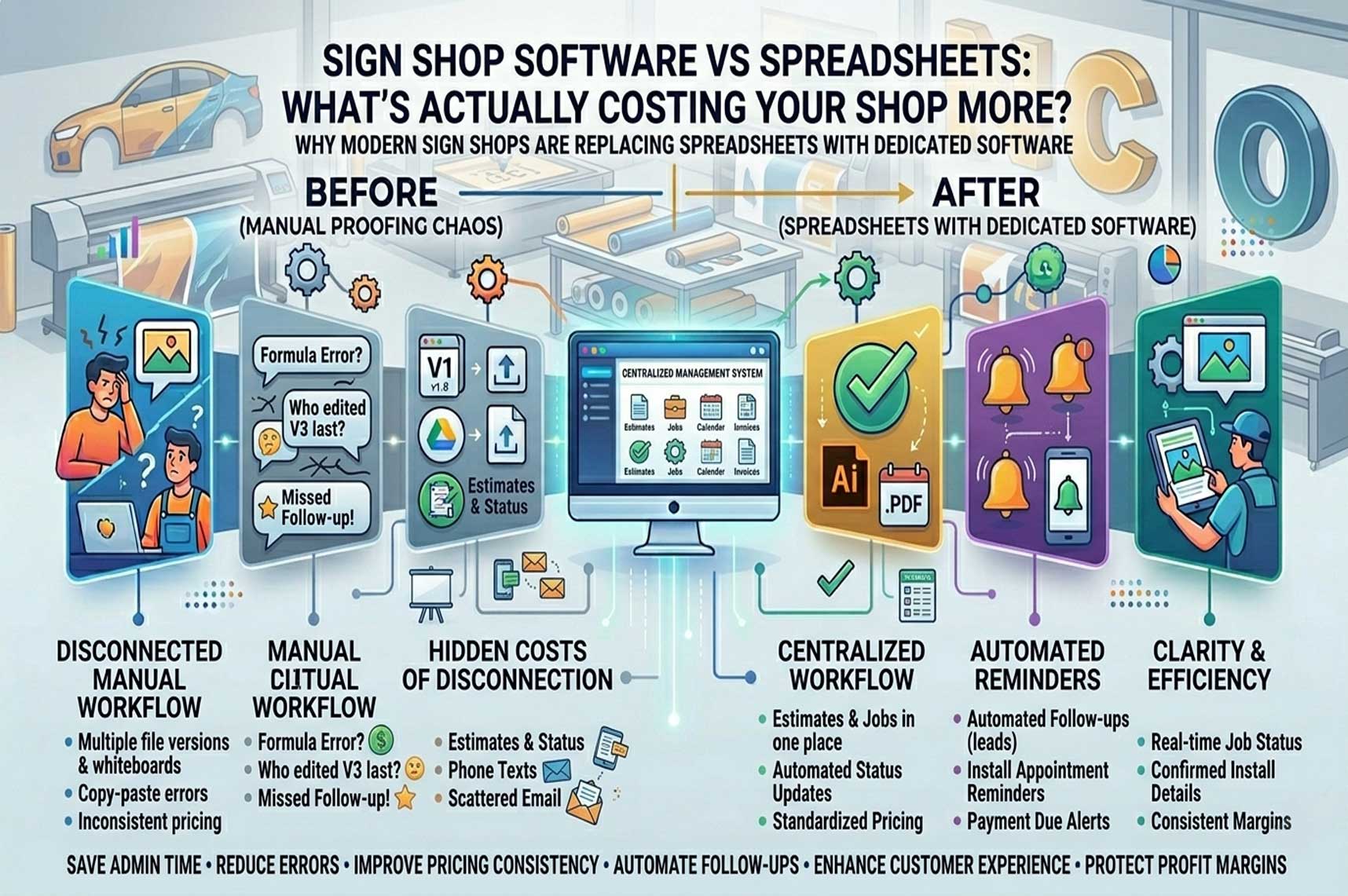
Most sign shops start the same way.
A spreadsheet tracks quotes. Another sheet lists jobs in progress. Someone writes install dates on a whiteboard. Invoices get handled in accounting software, and proofs move through email threads.
At first, it feels manageable.
Spreadsheets are flexible, free, and familiar. For a small shop handling a handful of projects at a time, they seem like the simplest way to stay organized.
But as the business grows, that system starts to strain.
More quotes. More installs. More employees. More communication with customers. Suddenly the spreadsheet that once felt efficient becomes a bottleneck.
This is the moment when many shops begin looking at sign shop software—not because they love new tools, but because the hidden costs of spreadsheets are becoming impossible to ignore.
Let’s look at what’s really happening behind the scenes.
Spreadsheets rely on manual entry for everything
Spreadsheets work only when someone keeps them updated.
Every estimate needs to be typed manually. Job statuses must be updated by hand. Install dates have to be entered and changed when schedules shift. Payment records get copied from one system to another.
This manual process creates two problems.
First, it takes time.
Second, it creates inconsistencies.
When several team members edit the same file (or when updates happen hours after a change) it becomes difficult to know what information is actually current.
Dedicated sign shop quoting software solves this by connecting tasks together.
Instead of entering the same data multiple times, the system updates automatically. When a quote is approved, it can create a job. When a job finishes, the invoice can be generated. When the invoice is paid, accounting records update.
That automation removes dozens of small administrative steps every week.
Human error quietly eats into your margins
A spreadsheet looks organized, but mistakes are surprisingly easy to make.
One incorrect formula can affect every estimate.
A missing line item can leave labor unaccounted for.
A simple copy-and-paste error can cause pricing inconsistencies.
These issues rarely stand out immediately. Instead, they show up later as smaller profit margins or jobs that take longer than expected.
The more projects a shop handles, the harder it becomes to catch these errors before they affect the bottom line.
The best sign shop software helps eliminate that risk by standardizing how estimates are built. Pricing rules stay consistent, calculations happen automatically, and estimates follow the same structure every time.
That consistency protects profit in ways spreadsheets often cannot.
Pricing becomes inconsistent across your team
When quotes are created manually, each team member may estimate slightly differently.
One estimator includes installation buffers. Another forgets. Someone adds design time while someone else assumes it’s already included.
Over time, this leads to unpredictable pricing.
Two customers asking for similar signage could receive completely different quotes depending on who created the estimate.
That inconsistency creates confusion internally—and sometimes distrust from customers.
With sign shop quoting software, pricing structures can be standardized. Labor rates, materials, and production steps follow the same logic across every estimate.
The result is faster quoting and more predictable margins.
Spreadsheets don’t remind anyone to follow up
Another hidden cost of spreadsheets is the absence of reminders.
When a customer requests a quote, someone has to remember to follow up. If that follow-up slips through the cracks, the opportunity disappears quietly.
Leads are lost not because the shop lacked capability, but because no one had a system prompting the next step.
Modern sign shop software includes automated reminders for follow-ups, payment requests, and upcoming installs.
Those small prompts help ensure opportunities don’t disappear simply because someone was busy that day.
Disconnected tools create unnecessary complexity
A typical sign shop running on spreadsheets might also use several other tools:
- Accounting software for invoices
- Email threads for proof approvals
- Calendars for install scheduling
- Messaging apps for internal communication
Each system contains a small piece of the project puzzle.
The challenge is that none of them talk to each other.
Information has to be copied from one platform to another. Team members need to check multiple places to understand the status of a job. Small delays occur simply because details are scattered across tools.
This is where a centralized sign shop management system changes the workflow entirely.
Instead of switching between five different platforms, everything lives in one place—from the initial estimate to the final invoice.
The advantage of a central system
When sign shops adopt dedicated software, the biggest improvement isn’t just speed. It’s clarity.
A central system means every project has a single source of truth.
Quotes, approvals, schedules, customer details, invoices, and job progress are connected. Team members can quickly see what stage a project is in and what needs to happen next.
This visibility helps shops stay organized even as project volume grows.
It also improves communication internally and with customers, which leads to smoother installations and fewer surprises.
Why many sign shops are moving to GarageTool
GarageTool was designed specifically for wrap and sign businesses that want to simplify their workflow.
Instead of juggling spreadsheets, calendars, and disconnected software, GarageTool brings estimating, scheduling, proofing, invoicing, and automation into one platform.
With GarageTool, sign shops can:
- Create consistent estimates using structured pricing
- Automatically generate jobs when quotes are approved
- Schedule installs and track project progress
- Send automated reminders for appointments and payments
- Sync invoices with accounting tools like QuickBooks
This unified system removes the inefficiencies that spreadsheets often introduce as shops grow.
The real cost comparison
At first glance, spreadsheets appear cheaper than software.
But the real comparison isn’t spreadsheet vs subscription fee.
It’s:
- hours spent on manual updates
- errors that reduce profit margins
- missed follow-ups that lose sales
- confusion caused by disconnected tools
When those costs add up, spreadsheets can quietly become the most expensive system in the shop.
Dedicated sign shop software replaces that complexity with automation, structure, and visibility.
For sign businesses that want to scale, that difference can transform how the entire operation runs.
Ready to move beyond spreadsheets and simplify your workflow?
GarageTool helps sign shops estimate faster, stay organized, and automate the daily tasks that slow teams down.
- ©2026 GarageTool
- Privacy policy
- Terms of service
- Sitemap